Multiply Labs is bringing Physical AI to life sciences—the first autonomous manufacturing platform for biologics, starting with cell therapy, the most complex manufacturing challenge in medicine. A full-stack system of robotics, software, and consumables, Multiply Labs gives pharma companies the power to own their manufacturing at industrial scale. The company delivers 74% cost reduction per dose and 100x throughput per square foot compared to manual manufacturing.
2–3 hours → seconds
for a workflow that previously required manually gathering, processing, and visualizing robotic event data
12+
data endpoints streaming continuously from a single deployed system to the cloud through one Foxlet
24/7
visibility across the full robotic system giving engineers always-on access to behavior across traditional robotic arms and proprietary electromechanical subsystems in one unified view
Overview
Multiply Labs is a robotics company building the physical AI layer for life sciences, on a mission to remove a critical bottleneck in modern medicine: manufacturing the advanced therapies that patients depend on. They work with leading pharmaceutical and biotech organizations, including AstraZeneca, Legend Biotech, and Kyverna Therapeutics, and partners with technology leaders such as NVIDIA and Universal Robots.
The next generation of biological therapies are getting rapidly approved for patients, but the manufacturing stack, built for small molecules and large batches, was never designed for the complexity, precision, and throughput these therapies demand. Multiply Labs’ answer is physical AI for life sciences: cloud-controlled robotic clusters that automate a manufacturer’s existing, already-validated instruments inside a closed, sterile environment. A single cluster combines traditional six-axis robotic arms with Multiply Labs’ own proprietary electromechanical subsystems, all orchestrated in parallel to execute the dozens of discrete unit operations that make up a biologics process.
That architecture creates a demanding observability problem. Across a single deployed system, many robotic and electromechanical subsystems act in concert, each generating its own stream of events, sensor readings, and state. To build, debug, and continuously improve a system that must run reliably and produce complete records, Multiply Labs’ engineers need to see, understand, and explain exactly what every subsystem did, and when.
That is where Foxglove comes in. Foxglove gives Multiply Labs a shared data platform for analyzing robotic behavior across live systems and historical events. Instead of manually searching machines, collecting scattered files, post-processing data, and building one-off visualizations, engineers can stream system data continuously, inspect robotic events in context, and understand system behavior from one place.
“Building robots that manufacture patient doses requires understanding exactly what every subsystem does, on every run. Foxglove gives our engineers that visibility across the whole system, and turns every robotic event into data that makes our platform better.” Fred Parietti, Co-founder and CEO, Multiply Labs
Impact
-
From hours to seconds to understand a single robotic event. Reconstructing what happened during one robotic event used to be a manual exercise that took two to three hours of gathering and stitching together logs. With Foxglove, that work happens automatically, and engineers can gather and visualize a single event in seconds rather than hours, dramatically shortening every debug and iteration loop.
-
One Foxlet, a whole cluster monitored as a fleet. A single deployed system exposes more than 12 data endpoints, all constantly streaming robotic events to the cloud through one Foxlet. In effect, one robotic cluster behaves like a fleet of many smaller robotic and electromechanical systems, and Foxglove lets Multiply Labs monitor all of them in parallel with minimal overhead.
-
Every robotic event, analyzed at once and around the clock. Instead of inspecting events one at a time, the team can analyze and visualize all of its robotic events together. With Foxglove streaming 24/7 across its robotic systems, Multiply Labs has continuous visibility into system behavior, not just snapshots captured after something goes wrong.
The Challenge: Life before Foxglove
Like many robotics teams, Multiply Labs faced a familiar problem: understanding complex system behavior can quickly become a tooling problem of its own. A single cluster is not one robot but many subsystems acting together, traditional robotic arms alongside proprietary electromechanical hardware, each producing its own events and sensor data. As the systems grew more capable, the volume and complexity of that data grew with them.
Before Foxglove, making sense of a single robotic event meant manually gathering logs from multiple sources and reconstructing the sequence after the fact, a process that could take two to three hours per event. Worse, engineers were largely limited to looking at one event at a time, which made it hard to see patterns across subsystems or across runs.
This kind of workflow does not scale well for a company building production-grade robotic biomanufacturing systems. As the number of subsystems grows, the number of possible interactions grows with it. A single robotic event may involve motion planning, control software, mechanical behavior, sensors, proprietary electromechanical components, and the manufacturing protocol itself.
For Multiply Labs, the challenge was not simply collecting data. The challenge was making that data usable fast enough for engineers to improve system performance, investigate anomalies, and keep scaling a reliable robotic platform.
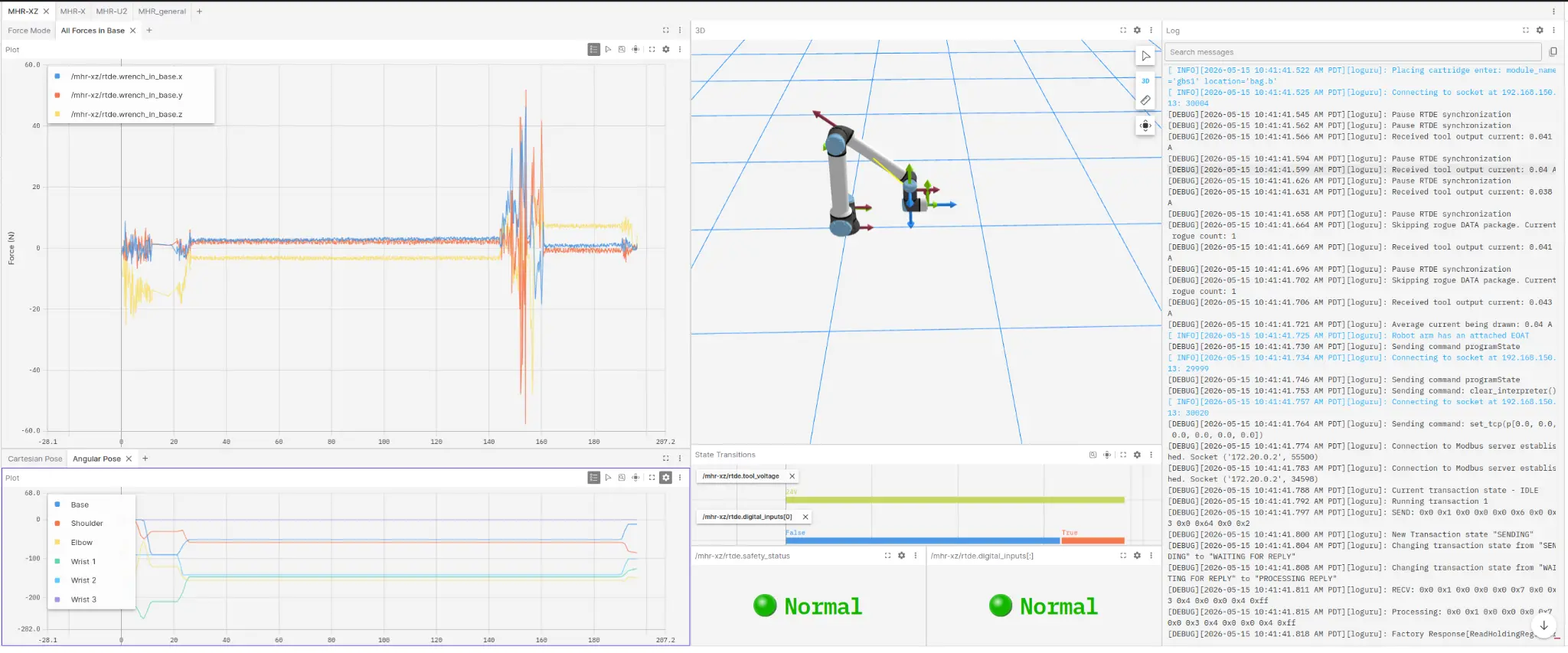
Foxglove layout showing 3D robotic-arm visualization, telemetry plots, logs, and live status indicators from a Multiply Labs run.
The Solution: A unified data layer for every robotic event, subsystem, and run
Today, Foxglove is part of how Multiply Labs observes, investigates, and improves its robotic systems. Multiply Labs streams robotic system data to the cloud through Foxglove, including data from traditional robotic arms and proprietary electromechanical subsystems. A single deployed system includes more than 12 data endpoints, all constantly streaming robotic events using one Foxlet. This gives the team a unified way to understand system behavior without stitching together separate tools for each subsystem.
“Foxglove gives us one place to see everything our systems are doing, across the robotic arms and our various subsystems. Instead of chasing logs across machines, we stream every event to the cloud and inspect it in context. That continuous visibility is what lets us catch issues early and keep improving how the systems run.” Juan Borbon, Staff Robotics Software Engineer, Multiply Labs
When an event occurs, engineers can open Foxglove and inspect the relevant context: logs, sensor readings, robotic state, and visualizations of robot behavior. Instead of spending hours gathering data and manually generating plots, the team can see what happened across the system from a shared interface.
That changes the debugging workflow. Engineers can move from “Where is the data?” to “What does the data tell us?” They can compare signals, identify anomalies, review how the robot behaved, and understand how different subsystems interacted during the event. For a system with many interconnected components, that shared context is critical.
Foxglove also reduces the cost of observability as the system grows. A robotic cluster can be thought of as a fleet of many smaller devices operating together. Without a unified platform, every new subsystem can create another data stream to manage, another visualization workflow to maintain, and another source of engineering overhead. Foxglove lets Multiply Labs monitor many of those devices in parallel with minimal overhead.
The Data Flywheel: Scaling robotic systems through continuous improvement
For Multiply Labs, Foxglove is not only a debugging tool. It is part of a larger data flywheel. Every deployed robotic system produces real-world data. Foxglove helps capture that data continuously, preserve the context around robotic events, and make the data easy for engineers to analyze. As the team reviews more events, they can better understand what normal system behavior looks like, identify the signatures of small deviations, and detect when something is changing over time.
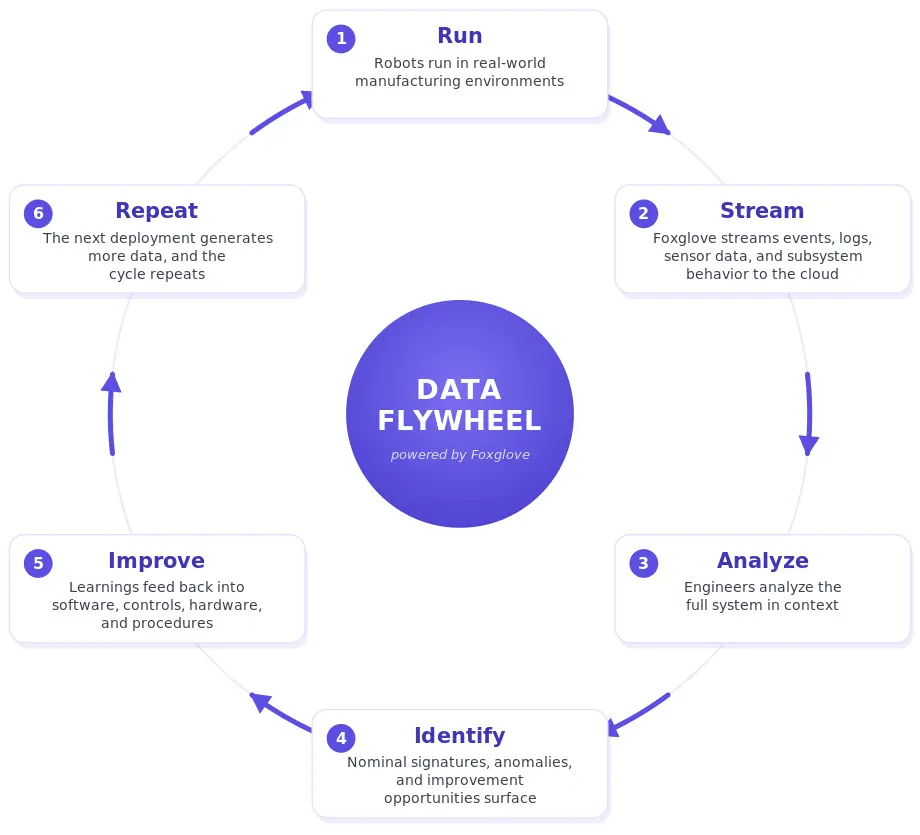
Foxglove helps Multiply Labs turn every robotic run into a continuous data flywheel—streaming, analyzing, and applying insights to improve future deployments.
This flywheel matters especially for Physical AI. Robots need to learn from real-world operation, not just from controlled test cases. By making robotic events easier to capture, visualize, and understand, Foxglove helps Multiply Labs turn production data into engineering leverage.
Looking Ahead: Building the foundation for scalable robotic biomanufacturing
As Multiply Labs scales its robotic clusters and expands the number of systems in operation, observability becomes even more important. More robots means more data, more subsystem interactions, and more opportunities to learn from real-world behavior.
Foxglove gives Multiply Labs a foundation for that growth. With 24/7 streaming, cloud-based event access, and unified visualization across robotic and electromechanical systems, the team can understand system performance without increasing internal tooling overhead. For Multiply Labs, that means engineers can spend less time assembling the data they need and more time improving the robotic systems that will help make advanced therapies more accessible.