Introducing the Agentic Data Platform for Physical AI
Collect, debug, search, and curate robotics data across the full lifecycle—with agents built into the platform.

In the lab, robots often reach 95% success rates. In the real world, the same robots struggle to clear 60%. Closing this simulation-to-real world performance gap can take months.
These performance gaps are the defining challenges for physical AI today. The bottleneck is turning physical AI data into learning. It’s about how fast you can learn from real-world data, turn that learning into validated improvements, and deploy them in production.
Speeding up the physical AI learning loop
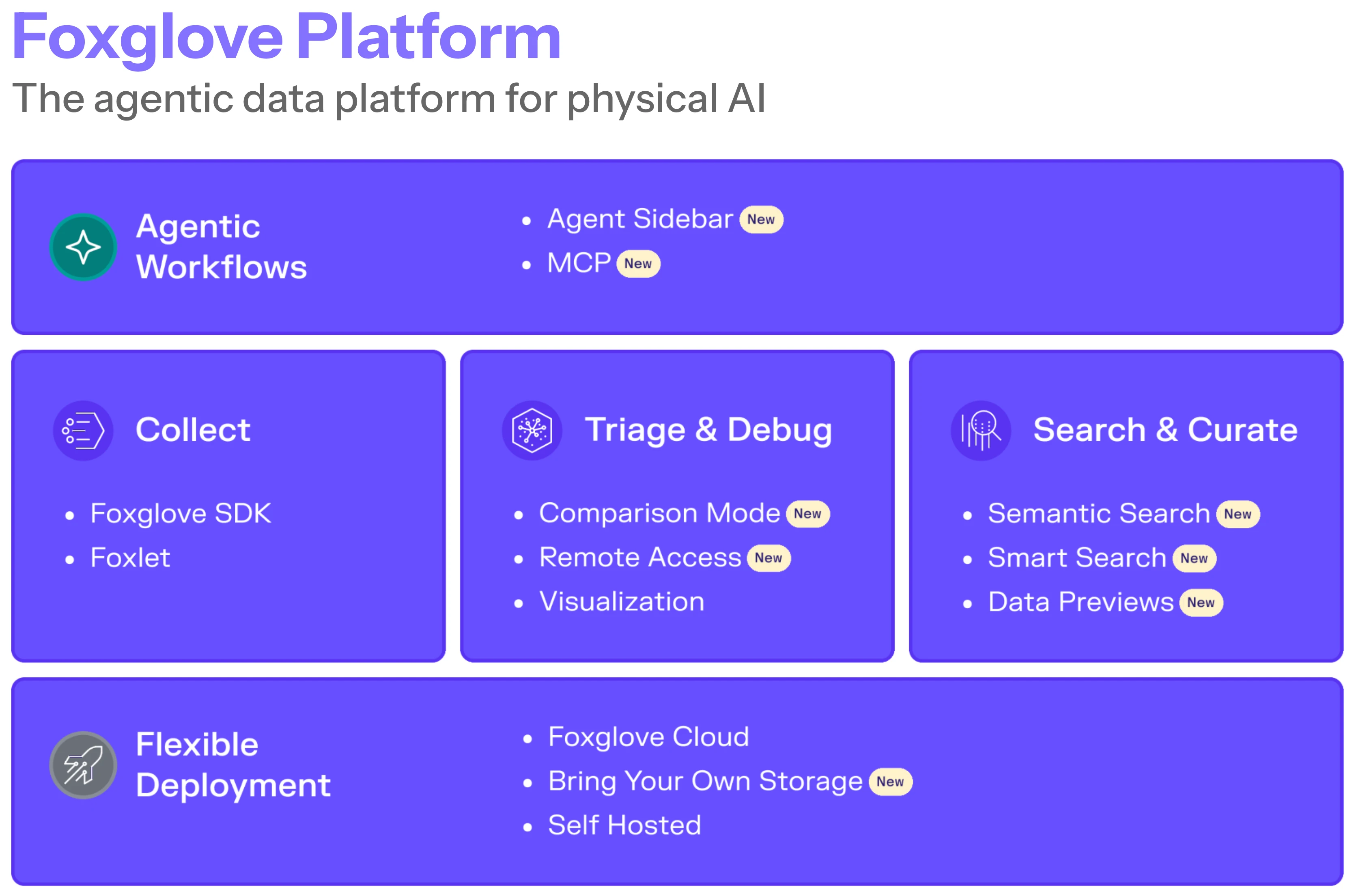
At Foxglove, our mission is to accelerate the physical AI learning loop. Today we’re introducing new capabilities to the Foxglove Platform, making it the agentic data platform for physical AI to rapidly build, monitor, and improve robots across the data lifecycle. These capabilities help developers easily connect and collect data from live robots; more effectively triage and debug robot performance; more quickly search and curate recordings to find the events that matter.
Start with intent, not a file
The Agent Sidebar built into the app is the agentic front door to the platform. No longer do developers need to move between screens to search and load recordings, create layouts or get answers to questions. The agent derives the intent of the user’s request based on the context. Describe what you need in natural language, and the agent searches, reasons, configures, and acts — grounded in your actual robotics data. Every answer cites the topic, timestamp, or schema it came from.
For example, you can ask it to:
- “Find every run where localization confidence dropped below 0.6.” A search page will open with the results.
- “Build a triage layout for yesterday’s autonomy runs with camera feeds, planner state, and localization confidence.” The layout will appear.
- “Find episodes similar to this one and add them to a training dataset.” The dataset is updated.
- “What happened at this failure?” The answer comes back, grounded in the MCAP file, schemas, topics, and values.
“It replaces a whole flow for me. Instead of writing scripts or tabbing through all the plot fields myself, it just creates everything for me.” Alex David, Software Engineer, Cobot
For teams that live in Claude, ChatGPT, Gemini, or Cursor, the Foxglove MCP exposes the same capabilities as a standard tool any agent can call — so you can ask “what failed in last night’s runs?” without ever opening the app.
See your data like never before
With traditional visualization and debugging tools, comparing runs to see what has changed requires juggling between separate windows, holding several timelines in your head while you squint to see whether a velocity spike lines up with the state change. The Foxglove Platform changes that.
Comparison Mode lets you review multiple runs in the same visualization environment — a resim against the baseline, a new model against old, a failure event against a success. You can load any number of data sources onto a shared timeline, and view the data from these sources together, either overlaid or side-by-side.
“Comparing multiple runs is valuable because Overland AI™ operates various platforms and needs to determine which performs best in a given environment. Side-by-side comparison allows us to enable regression testing, ensures optimal performance, and helps us assess how environmental factors can be mitigated.” Gaeson Redd, Autonomy Data Specialist, Overland AI
Find what you need faster
Names, timestamps, and device labels rarely tell you whether a recording has what you’re looking for.
Traditional search tools require specifying exact metadata and you still need to open a file to know what’s in it. Earlier this year we introduced Data Search that let users search and query MCAP data at petabyte scale, with no warehouse to set up and no copies of the data to keep in sync.
Today the Foxglove Platform takes that to the next level. We’re replacing manual filtering with search that actually understands your data. Semantic Search lets users describe a behavior or scenario in natural language, and Foxglove retrieves the matching multimodal segments from across large volumes of unlabeled data. So you can ask for “highway merges at night with poor lane detection” and get matching runs — no filters, no memorizing field names. Semantic Search is powered by industry leading models, including NVIDIA Cosmos’s video-text embedding model purpose-built for Physical AI. NVIDIA Cosmos is a family of open frontier foundation models trained on robotics, driving, and ego-centric human action data, and delivers state-of-the-art retrieval accuracy on physical AI benchmarks. Foxglove users will be able to choose the model they want based on their requirements. Semantic Search is currently in beta, available on Foxglove-hosted sites and on Bring Your Own Storage sites backed by AWS or Google Cloud Storage. See Introducing Semantic Search for details.
Search is also smarter now, combining columnar and visual search in a single query. Making it easier to write structured, fast-running queries through an intuitive auto-complete experience in the search box.
Data Previews visually surfaces camera thumbnails, 3D spatial snapshots, GPS traces, and sparklines directly in the search results and recording tables, so you know if a file has what you need before you open it.
Once you find the files you need, Sessions and Events, which we introduced earlier this year, turns them into action. They let you group recordings into logical runs, annotate the moments that matter, and provide your team a shared, curated dataset.
Access live data, not just files
Remote Access is generally available today. It provides a one-click connection to any robot anywhere in the world that has an internet connection, and it doesn’t require the same network. It automatically handles all the painful downsampling and compression adjustments to ensure the connection stays real-time.
It can stream every topic from a robot in the field, live to Foxglove. This includes camera, Lidar, telemetry, logs, all at low latency and in the same application as the user’s recorded data.
This lets engineers observe and debug a deployed system in real time directly through Foxglove from wherever they are. The bi-directional communication supports teleoperation, and the on-device remote access gateway keeps robots reachable even behind a firewall or on cellular networks.
Purpose-built for physical AI
Foxglove’s data platform spans collection, debugging, storage, mining, and curation — built around MCAP files and multimodal sensor streams, with SOC-compliant Foxglove-hosted or self-hosted deployment options. Bring Your Own Storage is now available to both Foxglove Enterprise and Foxglove Pro plan customers. Connect Foxglove directly to your AWS S3, Google Cloud Storage, or Azure Blob buckets, and we index and query the data in place. No duplication, no second copy to keep in sync — you keep ownership of your files and layout.
As robotics companies adopt agentic workflows, Foxglove is designed to be the data platform developers use and trust.
Getting started
The new capabilities in the Foxglove Platform are live starting today. Come see them in action at Actuate ‘26 or book a demo with our technical team.
Our engineers will demo these features live on September 2, 2026. Register now.